Our Latest News
Check out what’s been going on in our world!


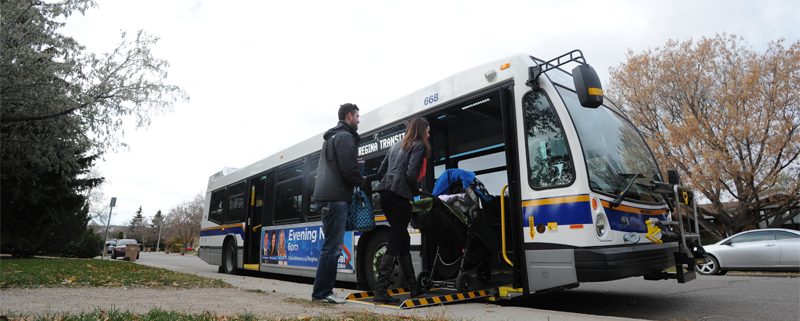
Low floor buses are on all Regina bus routes and allow for easy access on and off the bus since low floor buses have · No stairs to climb · The ability to ‘kneel’ to get close to curb level · A low-angle ramp that unfolds to allow people with wheelchairs, scooters, baby carriages, or carts to board the bus.
A! Student Researchers Kennen Dorgan, Kaitlyn Hoar, and Sean Davis took their first rides on City of Regina public buses in October.
Sean has a network with the Realm Foundation. His network facilitator, Cindy Leggott, suggested he expand his transit options by trying out the regular city buses (Sean also uses the services of ParaTransit). Sean and his teammates Alix Norum and Parker Florell, prepared for their ride by checking transit maps, planning travel time, then Parker and Alix did a test run. This was a clever idea because they got on the wrong bus and saw much of the city over a two-hour period. Sean was happy to miss that experience. On their actual travel day, they went from the University of Regina to the Cornwall Centre and returned to the University. It was smooth sailing, and Parker got a new name. A person standing outside the mall saw Parker and called out, ‘Hey Cowboy Man’ because of his distinctive cowboy hat. You can check out their trip photos here
These are their travel tips: If you have a large power chair take the bigger spot behind the bus driver, there is an accessible stop button beside this space, push the button to alert the driver that you will need the ramp lowered at the next stop, you use the same bus pass as the one for ParaTransit, and if you need someone to assist you on the bus your assistant does not need to pay a bus fare.
The team of Kennen, Kaitlyn, Hannah Merk, and Julia Peters chose the same bus route as Sean’s team. To prepare for their trip they talked to ‘Team Sean’ about their experience, phoned the City Transit Line (306-777-7433) for bus information (very helpful), and learned some things from their bus driver. They all agreed that using public buses was a lot easier than they thought it would be. They stopped for lunch at the mall, did some shopping, and Kaitlyn loved getting her eyebrows threaded before returning to the University. You can check out their trip photos here.
These are their travel tips: There are two spaces for wheelchairs, with tie-downs for the space behind the driver, and on the opposite side, a device that holds the wheelchair in place.They were all impressed with this device. In the space behind the driver the person in the wheelchair faces the front of the bus, on the opposite side the person in the wheelchair faces the back of the bus.
Additional tip – if you are waiting at a bus stop and not sure when your bus will arrive, text 306-596-6136 and put the bus stop number in the message (the number is at the top right of the bus stop sign). You will get a reply telling you when the next bus should arrive at your stop.

Dr. Brenda Rossow-Kimball, Astonished! Board Chair, and Assistant Professor in the Faculty of Kinesiology and Health Studies at the University of Regina, brings together Strengths Perspectives theory, and conversations with the parents, founders, and vision keepers who began Astonished!
She writes:
Historically, the dominant narrative in the ‘helping’ professions such as social work, disability studies, and medicine have taken a ‘deficits-based’ approach; a professional assesses an individual’s problems and creates an intervention to ‘deal’ with their inadequacies, illness(es), deficits, lack of achievement or functioning, and so on (Anderson & Heyne, 2012). The nature of the ‘helping work’ undertaken by professionals is situated in a negative state and defined by one’s problems. The strengths perspective is an attempt to write a counterstory of possibility, hope, expectation, and independence in response to a dominant grand narrative of inadequacy, hopelessness, underachievement, and dependence.
Saleebey (2009) writes that the incentive to develop a strengths perspective is a response to “our culture’s continued obsession with psychopathology, victimization, abnormality, and moral and interpersonal aberrations” (p. 2). For example, a deficits approach sees the person as a ‘case’ or ‘diagnosis’ whereas the strengths perspective sees the person as unique with talents and resources; the deficits approach creates an intervention that is problem-focused whereas the strengths perspective will initiate support that is possibility-focused; the deficits approach sees the professional as the expert whereas the strengths perspective sees that individuals, families, and communities are the experts; finally, the deficits approach aims to eliminate illness or dysfunction whereas the strengths perspective aims to enhance one’s well-being and quality of life (Anderson & Heyne, 2012).
“Families are the basic, foundational social units in every society (DeFrain & Asay, 2008, p. 2), yet research on ‘families’ has typically taken a deficits-based approach by emphasizing the problems or weaknesses in families or by highlighting the individuals in the family unit who causes ‘problems’ or stress. For families who live alongside a child experiencing disability, the dominant narrative is negative, citing the experience as stressful (Aneshensel, 2014), depressing (Emerson, 2003), hopeless, ‘copeless’, laborious, and burdensome, leading to family dysfunction and breakdown (McConnell & Savage, 2015). However, “If one looks only for problems in a family, one will see only problems. If one also looks for strengths, one will find strengths” (Defrain & Asay, 2008, p. 5).
My thinking has been inspired by the initiative and ingenuity of the parents and vision keepers who began Astonished! many years ago. Because little research focuses on the positivity and strengths within families when facing new and unexpected challenges, I thought the strengths perspective would be an appropriate framework in which to think about the lived stories of mothers and fathers who are parenting a family unit that is experiencing disability.
The strengths perspective suggests that when facing adversity, we ought to put the lens of focus on “what people want their lives to be like, and what resources and strengths they have or need to get there” (Saleebey, 2006, p. 12), I have learned that families, indeed, pull on their strengths and resources to regain and maintain the coherence that existed prior to disAbility. As one parent stated so well, “Everybody sets a bar for their family standards. Ours simply adjusted and now this is our normal. You readjust your normal.” For families experiencing disability, the framework of the strengths perspective may be a response to the longstanding dominant narrative that suggests the experience of parenting is primarily laborious, onerous, family-breaking, and dysfuntional. Families carry on [with] “one foot in front of the other”, “extreme strength”, and “no fear”.
“It’s just ordinary life.”
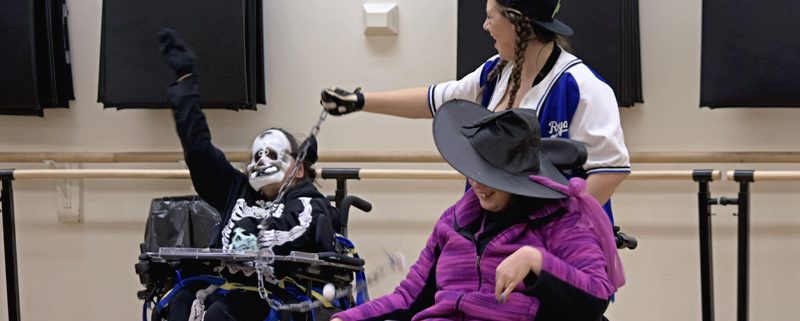
We celebrated the last A! Dance Project of the year – Halloween Edition!
With instruction from our friend MacKenzie Drumm, we found our own rhythms, channeled our inner Halloween spirits, and danced to some spooky tunes. Sean took the prize for the best Spooky Spirit. Thank you to the Saskatchewan Community Initiatives Fund for your generous support of the A! Dance Project. To see photos from the evening click here…..
Photo: Ashley, Megan, Amanda
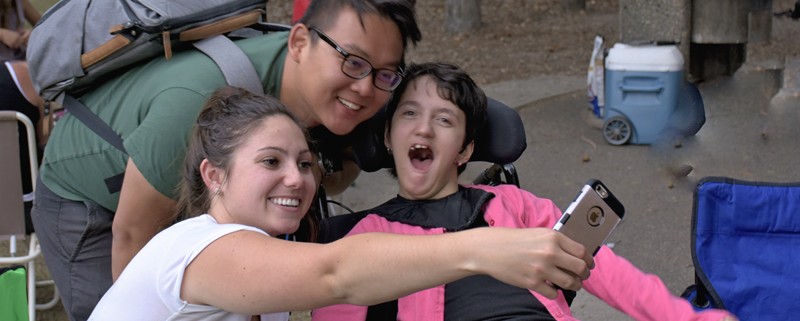
It is amazing how much can happen in two months. Check out what has been happening at Astonished! during July and August 2017. We are having a wonderful time creating inclusive culture.
Photo: Bobbi-Jo Schmitz, Kevin Ma, Kaitlyn Hoar
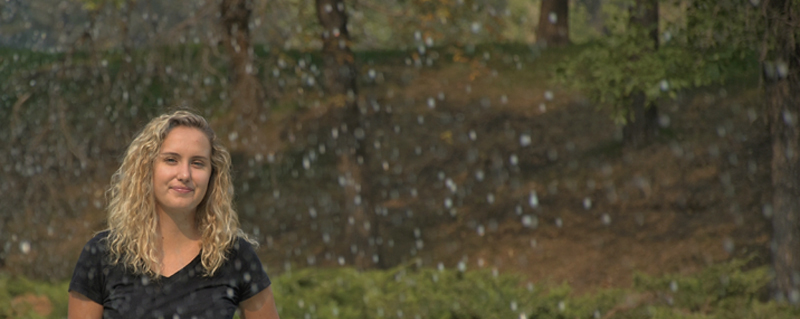
We are delighted that Jessica Opdahl chose Astonished! for her Health Studies field placement (Faculty of Kinesiology and Health Studies). Jessica is in her final year of Health Studies and hopes Occupational Therapy will be in her future. As part of her Health Studies degree Jessica has taken five courses in Indigenous Health Studies. This has helped her see health care and the wider world from different perspectives.
Jessica loves exploring unfamiliar places, whether in Canada, North America, or different continents. This past summer she travelled in Asia, spending time in the Philippines, Bali, and Vietnam. Although shy by nature, she likes to challenge herself, and sometimes travels on her own. In Asia, she was grateful for the opportunity to met new people, visit places unlike anything she had ever seen before, get through moments of culture shock, and carry many images of beauty and diversity into her daily life.
Jessica is getting comfortable with the Astonished! community, figuring out where she fits and what she can contribute. She is excited to learn, be involved with, and see what happens throughout her field placement. We look forward to discovering this together. Welcome Jessica.
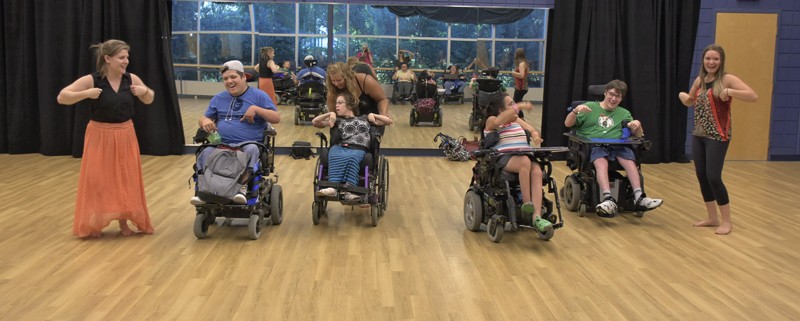
Did you know the chicken dance was composed in the 1950’s in Switzerland? And even more surprising, did you know many of the Astonished! community can rock the chicken dance? Under the guidance of teacher and choreographer, MacKenzie Drumm, Astonished! hosts the A! Dance Project several times a year. On Thursday evening, July 27th, we rocked it in the dance studio at the Riddell Centre, University of Regina. The chicken dance was a surprise introduction, in the midst of pop, country, hip-hop and other music. Thanks MacKenzie for leading the A! Dance Project in an evening of dance fun, and thanks to the Community Initiatives Fund for your support of the A! Dance Project. And of course the chicken dance must be followed by late-lunch! To see more photos from the evening………